

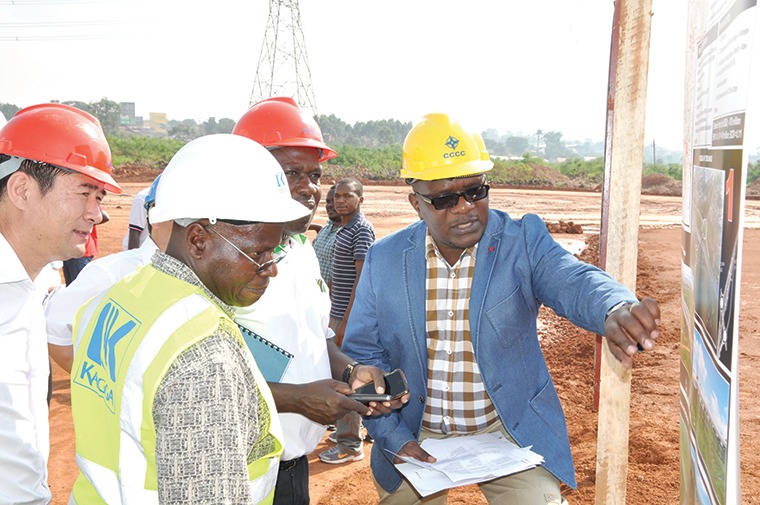
KAMPALA — In Uganda’s infrastructure sector, David Ssali Luyimbazi is widely known among engineers, planners, and development practitioners for his long career in public infrastructure planning and implementation rather than public visibility.
He has largely operated within technical and administrative roles across key institutions, including the Ministry of Works and Transport, the Uganda National Roads Authority (UNRA), and later the Kampala Capital City Authority (KCCA), where he has been involved in planning, systems development, and programme coordination.
As discussions continue around efficiency, delivery delays, and implementation challenges within the Works and Transport sector, some officials and analysts say attention has increasingly turned to experienced technical administrators within government structures, including Eng Luyimbazi.
Eng Luyimbazi’s professional path has largely been based inside Uganda’s public infrastructure ecosystem, where he has been involved in planning and management roles over several decades.
At UNRA, where he served as Director of Planning between 2008 and 2015, he was involved in the preparation and structuring of major road development programmes during a period of expansion in the national road network.
During that time, he participated in the preparation of thousands of kilometres of road projects and was involved in processes that supported the mobilisation of development financing from institutions such as the World Bank, JICA, the European Union, and China Exim Bank, according to officials familiar with the period.
He also contributed to early structuring work for some of Uganda’s public-private partnership road initiatives, including discussions around projects such as the Kampala–Jinja Expressway.
Beyond project preparation, former colleagues say his focus extended to strengthening internal systems for planning and monitoring.
“He understood that infrastructure is not only about roads. It is about systems,” a former UNRA official said. “His focus was on improving planning tools, monitoring frameworks, and internal coordination.”
Systems introduced during that period included planning databases and investment programming frameworks that were later integrated into sector processes.
The Ministry of Works and Transport continues to oversee some of the country’s most critical infrastructure portfolios, including roads, aviation, rail, and transport systems.
However, in recent years, the sector has faced scrutiny over project delays, procurement bottlenecks, maintenance challenges, and administrative inefficiencies that have affected implementation timelines.
Some analysts argue that while funding remains significant, execution capacity and institutional coordination have become key constraints.
“The challenge is no longer just resources,” one transport sector analyst said. “It is about implementation efficiency and how well systems are managed.”
Within that context, some observers point to the need for administrators with experience in both technical planning and institutional management.
KCCA experience and urban management exposure
After his tenure at UNRA, Luyimbazi served as Deputy Executive Director at Kampala Capital City Authority between 2020 and 2024, where his responsibilities expanded into urban governance and municipal administration.
In his role as accounting officer before Parliament, he oversaw urban infrastructure programmes, city road works, and digital systems aimed at improving service delivery and revenue management.
During this period, KCCA’s reported local revenue collections increased from about UGX 80 billion to over Shs120 billion annually, alongside the rollout of digital planning and management systems intended to improve coordination across departments.
Colleagues say the experience broadened his exposure from national road infrastructure to urban systems and institutional administration.
“He has worked both in engineering and in senior public administration roles,” one governance expert said. “That combination is not common in the public sector.”
Across the public service, Luyimbazi is generally described by colleagues as a technically oriented administrator with a focus on systems and delivery processes rather than public engagement or political communication.
“He is not someone who thrives on publicity,” a former colleague said. “He focuses more on whether systems are functioning and whether programmes are being delivered.”
Over time, he has built a reputation within technical circles as a long-serving civil servant with experience across multiple infrastructure institutions.
His academic background includes a Master of Science degree in Major Programme Management from the University of Oxford and a Master’s degree in Highway Engineering with Distinction from the University of Birmingham.
Discussions around figures like Luyimbazi reflect a broader debate within Uganda’s governance and infrastructure sectors about the balance between political leadership and technical administration in delivering public programmes.
As government continues to pursue large-scale infrastructure and economic transformation initiatives, some stakeholders argue that institutional performance depends increasingly on strengthening technical capacity within key ministries.
“The issue is whether public institutions are structured to deliver efficiently,” a sector analyst said. “That is where experienced technical administrators become important.”
For now, there has been no official indication regarding any change in his role or assignment.
However, within infrastructure and governance circles, his name continues to surface in discussions about institutional capacity and administrative reform within Uganda’s Works and Transport sector.
